Scottish Football Museum
Digital exhibitions
Scotland’s football heritage dates back centuries, from early games in the 15th century to the formation of the Scottish Football Association in 1873.

Showcasing Collections
SCOTLANDS FOOTBALL ORIGIN 1427 – 1873
Important items linked to Scotland’s early football history can be found within a diverse range of organisations and institutions. These include museums, galleries, libraries, schools, stately homes and, of course, football grounds.

1424
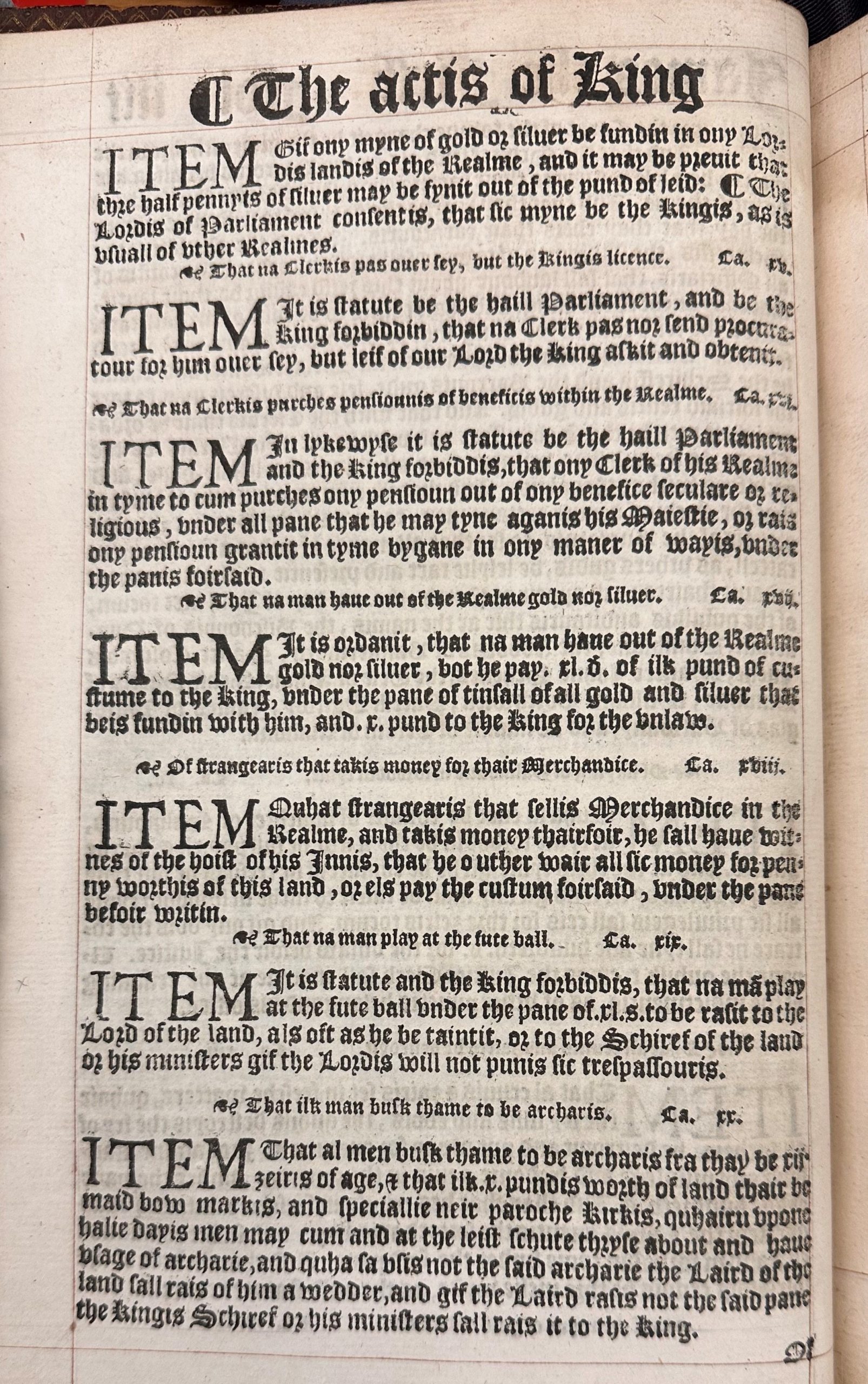
Act of the Scots Parliament
The earliest record of football in Scotland.
Learn More
“Of playing at the fut ball…” “…it is decreed and the king forbids that any man play at the football…” (Act of the Scots Parliament, Scone, Perthshire, 26 May 1424).
James I, King of Scots, had spent 18 long years as a prisoner of the English King before finally being released in April 1424. He headed home feeling rather resentful due to the long time that it had taken for his ransom to have been paid. As he arrived back in Scotland James was clearly determined to assert his authority. After being officially crowned at Scone in May 1424, the Scots Parliament was hastily convened. Amidst an array of proclamations, the ban on football was enacted.
There are a number of points which can be taken from this Act of Parliament. Firstly, football must have already been a popular activity enjoyed by the wider population for an Act of Parliament to have been required to ban it. Secondly, the activity must have been deemed by the King to be a distraction or a nuisance for this measure to have been taken. Finally, we can ascertain from future attempts to ban football in Scotland that the Act must have been limited in its impact. Similar bans would be attempted by subsequent Scottish monarchs in 1457, 1471 and 1491.
C. 1540S
Stirling castle football
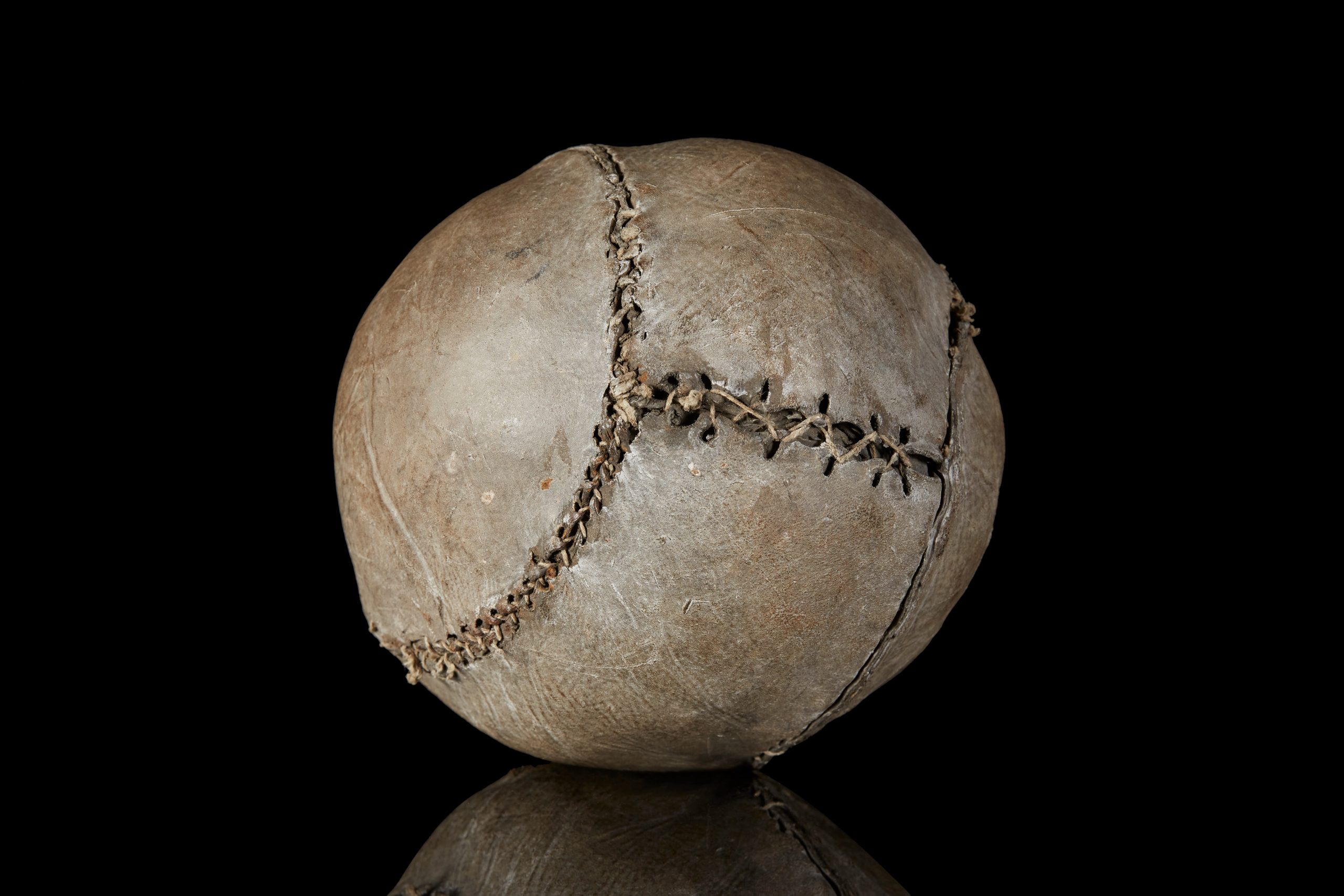
The oldest football in the world.
Learn More
Scotland is home to the earliest surviving example of a football.
Back in the 1970s, this football was discovered behind wooden panelling in the Queen’s bedchamber in the Royal Palace at Stirling Castle. It has been dated back to the 1540s and within the lifetime of Mary, Queen of Scots. The ball is made from an inflated pig’s bladder which is encased by cow leather. The reason as to why the ball got lodged behind the wooden panels remains a mystery.
It is known that Mary, Queen of Scots watched football. After losing the Battle of Langside in 1568 Mary fled over the border and was initially held at Carlisle Castle. A letter describing her time at the castle mentions her leaving the castle to visit a playing green…
… where 20 of her retinue played at football before her for 2 hours, very strongly, nimbly, and skilfully, without foul play, the smallness of their ball occasioning their fairer play…”
C. 1560
Statue of saint eloi
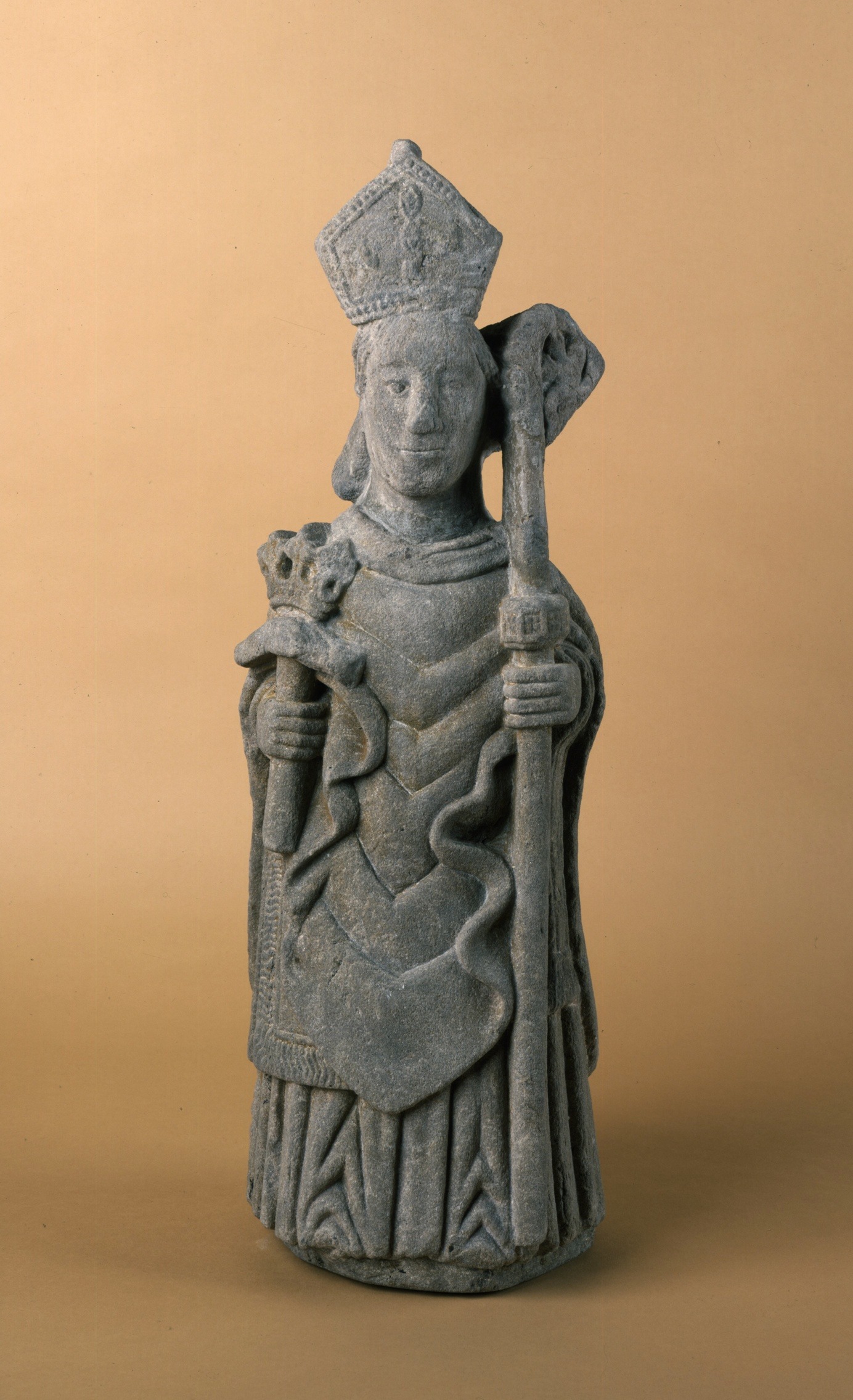
Football and the Hammermen of Perth.
Learn More
Football formed an important aspect of the customs and recreations of the Perth Hammermen in the 16th century.
Saint Eloi is the Patron Saint of Hammermen. The Incorporation of Hammermen is a traditional trade organisation which can still be found in towns and cities across Scotland. The incorporation covers a range of metalwork professions, from blacksmiths and sword makers to locksmiths and goldsmiths. This rare statue of Saint Eloi was discovered after being buried for centuries under the floor of the old Rutherglen Parish Church. It is the only statue of the saint to have survived the Reformation period in Scotland.
In Perth, football was an important activity amongst the Hammermen. In order to qualify as a master, an apprentice was required to present a high quality piece of work for inspection and would afterwards be required to pay a fee to the incorporation for a “banquet and football”.
In 1546 the apprentices in Perth were forbidden from leaving their place of work in order to follow their masters out to football games. The penalty for disobeying this rule was a fine of a “pound of wax” which was to be offered to “Sanct Eloy.”
1628
woment and men play football at carstairs
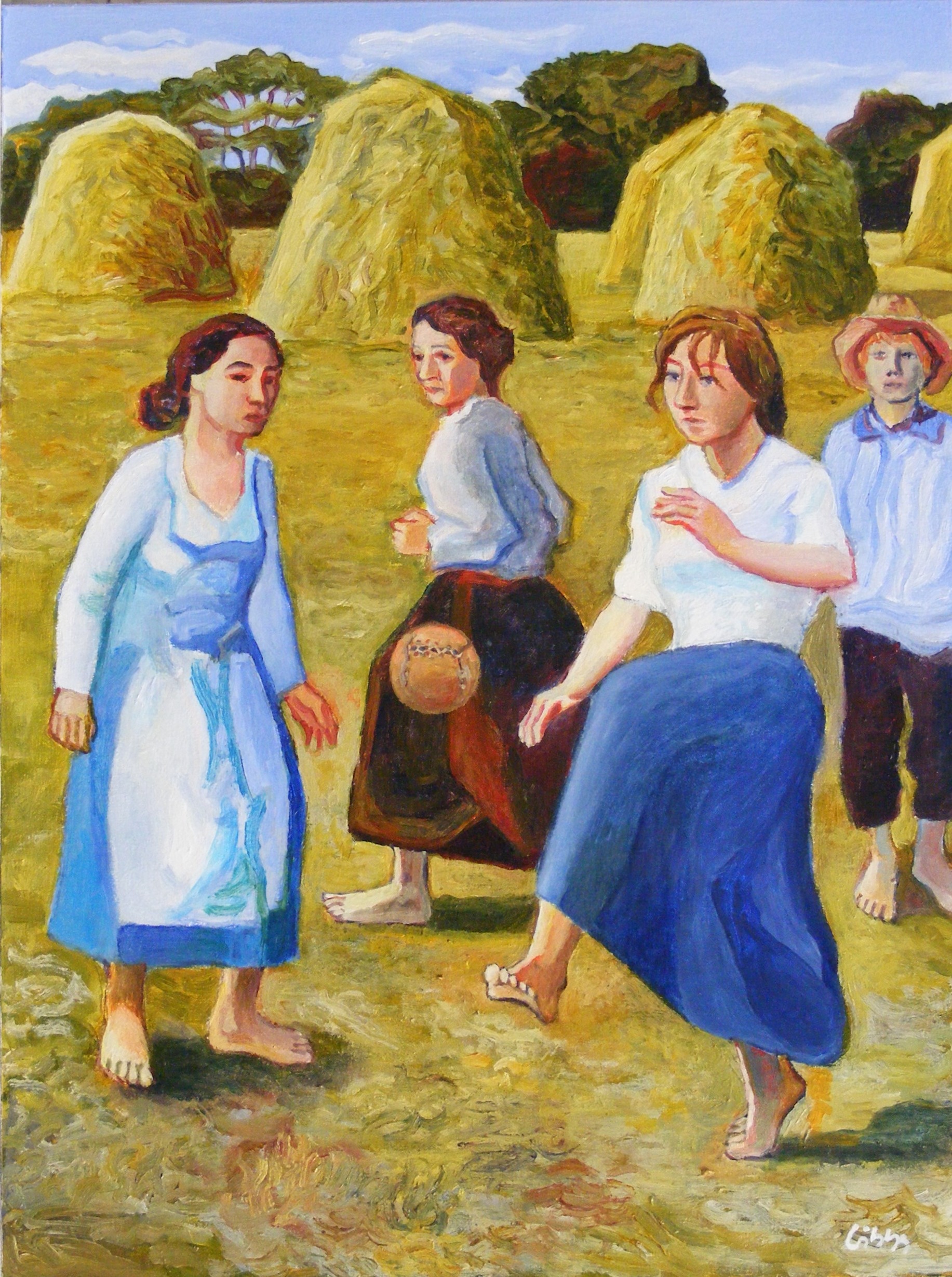
Painting of women playing at Carstairs.
Learn More
The reference provides the earliest example in Europe of women participating in a football activity.
This painting by artist and historian Stuart Gibbs depicts a scene of women playing football at harvest time in the Lanarkshire village of Carstairs. In August 1628, the local church minister, Rev. John Lindsay, angrily observed men and women taking part in “footballing, dancing and barley breaks.” The latter activity was a traditional harvest game played by mixed pairs of men and women.
The wrath of the minister was mainly down to the fact that these games had taken place on a Sunday. In the eighteenth century the Scottish Kirk believed that the Sabbath should be a solemn day solely devoted to the worship of God.
It is due to the Minister’s recording of this activity that Carstairs village is the earliest known location in Europe where women are known to have played at football.
1636
latin grammar book
Description of a football game at Aberdeen Grammar School.
Learn More
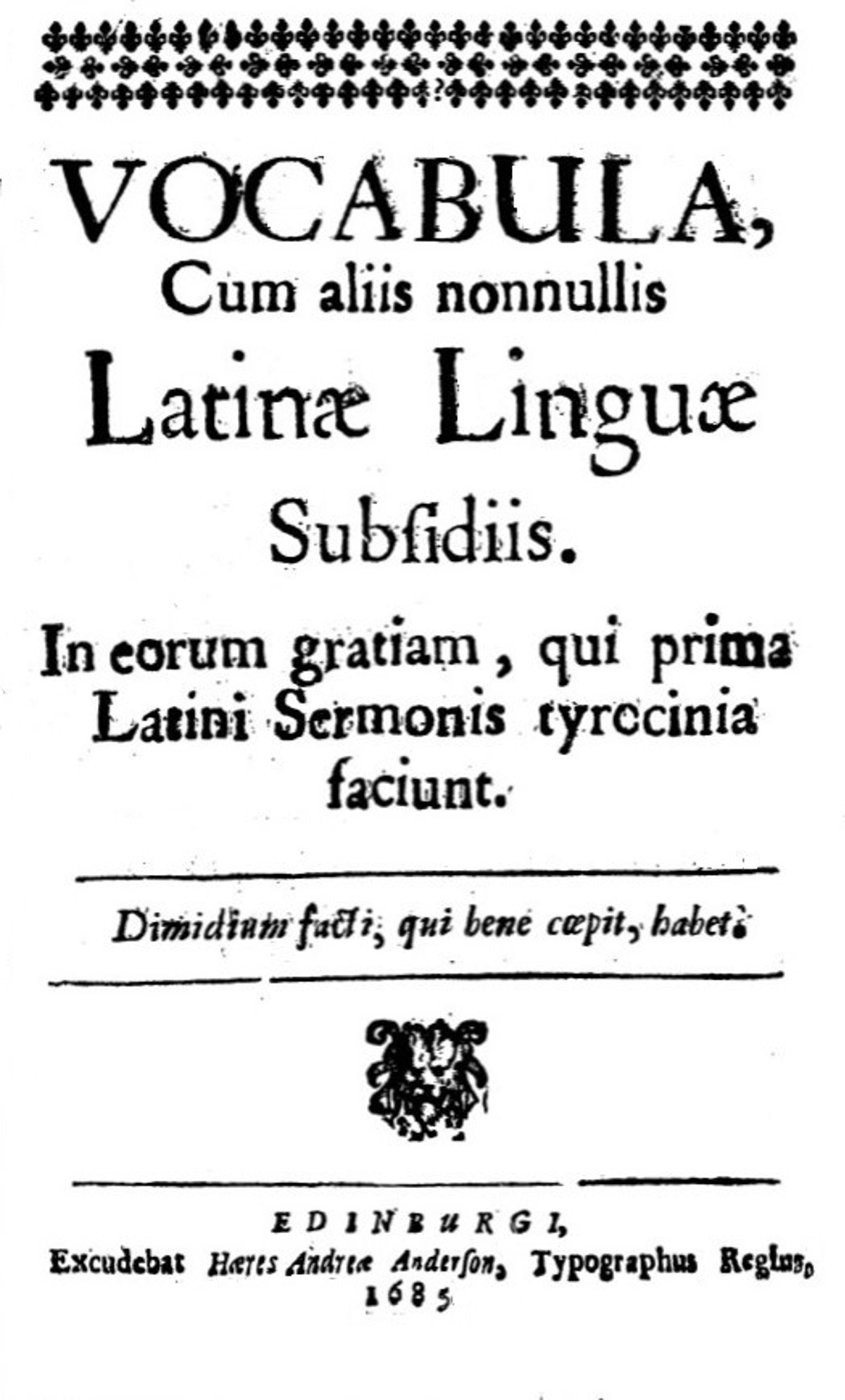
In 1636 David Wedderburn, Schoolmaster of Aberdeen Grammar School, completed his Latin grammar book “Vocabula”. In order to help his pupils learn Latin, some of the passages focused on recreational activities that the pupils enjoyed, like golf, bowls, archery and “pila pedalis” which translates as “football”.
The Latin text at the beginning of the football passage describes the organisation of a game with players being picked in turn. A description of a game then follows.
The text describes some skilful play, with references to the ball being passed and even the use of goalkeepers… “you defend the goal”. Although the text is mainly in Latin, some of the passages are repeated in Scots to assist with the learning. For example, “to give the hail” means “to give the goal”. “Hail” is a traditional term for “goal”. Although the original work of 1636 has not survived there are numerous copies of the book in existence dating from the late seventeenth and early eighteenth century.
This translation is kindly provided by Graham Robertson, Teacher of Classics and former pupil of Aberdeen Grammar School.
Football
Let us pick teams:
You choose the first man.
Those who are on our team come over here.
Who are against us?
Kick the ball out so we can begin the game:
Come on, kick it over here.
You defend the goal.
Take the ball from him if you can do it.
Come on, throw yourself in his way.
Run at him.
Kick the ball back: very well done
You do nothing to score a goal with the ball
This is the first goal
This is the second, this is the third goal:
Drive him back otherwise the opposition will come out on top;
Unless you watch out he will take possession of the goal:
Unless we play better we are done for:
Ha, the victory is with you; hurrah you’ve won!
He is very skilful with the ball
Had he not been there, we would have won the victory,
Come on, serve me,
We still have the stronger team.
1724
Town drum
Bailie confiscates the town drum to prevent the annual football game.
Learn More
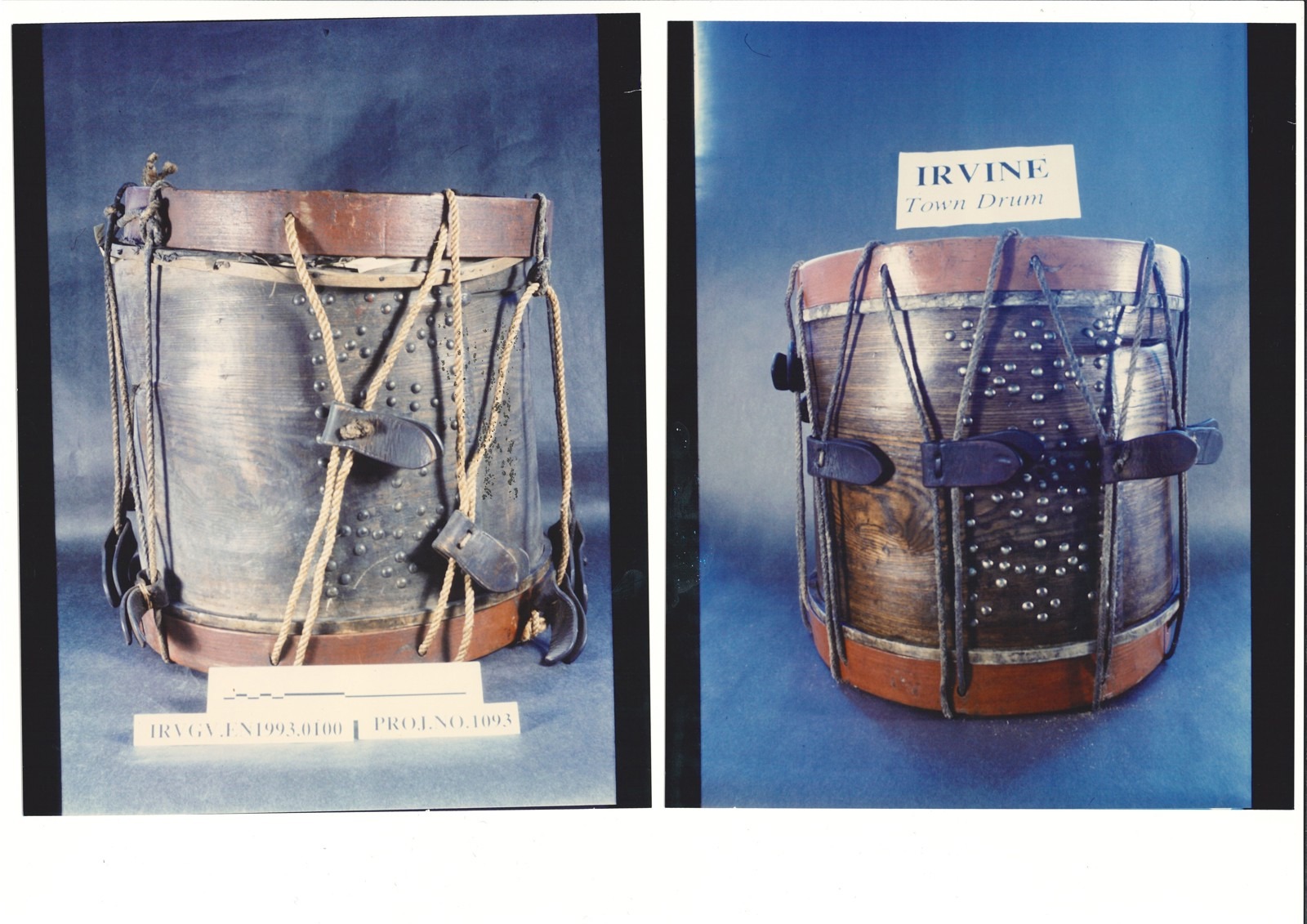
From the west coast town of Irvine in Ayrshire to the Borders town of Duns in Berwickshire, the town drum was a traditional symbol of civic authority.
In the Berwickshire town of Duns on Fastern’s E’en (Shrove Tuesday) the local townsfolk were traditionally summoned to their annual football game by “tuck of drum”. In 1724 Bailie John Grey tried to stop the game from taking place by confiscating the drum. Although the football game went ahead, the participants were very angry at the attempt to suppress an important local custom. This displeasure led to physical action and a riot broke out within the town.
In towns across Scotland, important announcements were made by tuck of drum. A drummer took part in a formal procession through the streets and proclamations were issued at important locations such as the Mercate (Market) Cross. The drum used at Duns has not survived and the one which is featured for the purpose of the story is from the Ayrshire town of Irvine. Although the exact age of the Irvine town drum is not known it is fairly typical of the type that would have been used in towns across Scotland during the 18th and 19th centuries.
1785
POEM BY ROBERT BURNS
Epistle to Davie, a brother poet
Learn More
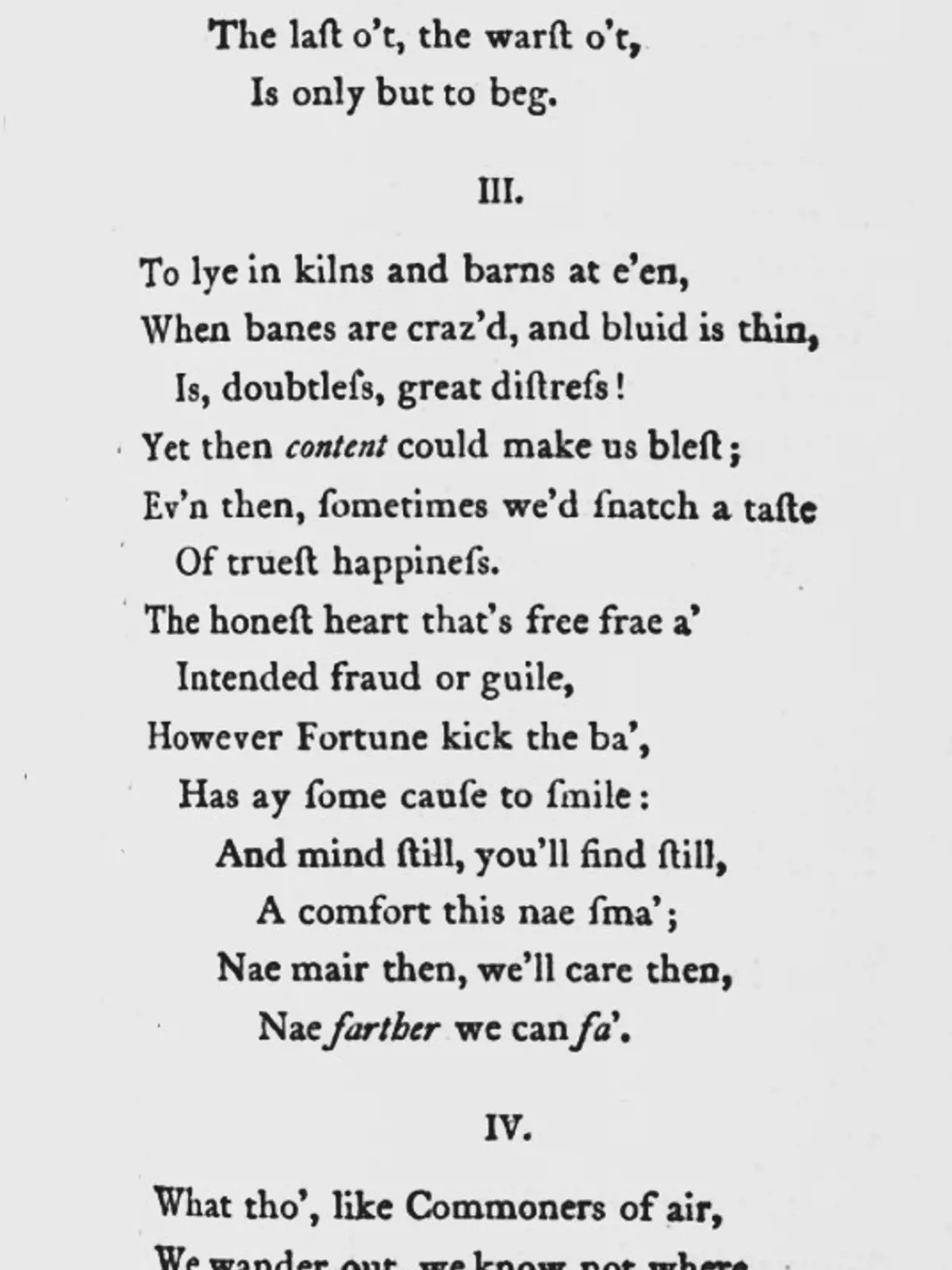
This poem was penned in 1785 and appeared in the first edition of Poems, Chiefy in the Scottish Dialect in 1786. More commonly referred to as the Kilmarnock edition, this book was the first ever edition of Burns’ work to be published.
Robert Burns wrote this poem as a tribute to his friend David Sillar. David was a teacher from Tarbolton in Ayrshire who was a member of the Tarbolton Bachelors Club. This society had been co-founded by Burns in 1780. The poem contains the following lines…
The honest heart that’s free frae a’
Intended fraud or guile,
However Fortune kick the ba’,
Has aye some cause to smile.
With this particular verse, Burns uses the activity of football as a metaphor for fate. The importance of football and other ball games in Scottish life can often be seen by its wide use in poems and ballads in the 16th, 17th and 18th centuries.
1795
SKETCH OF WOMEN PLAYING FOOTBALL AT FISHERROW
The Fishwives of Fisherrow play football
Learn More
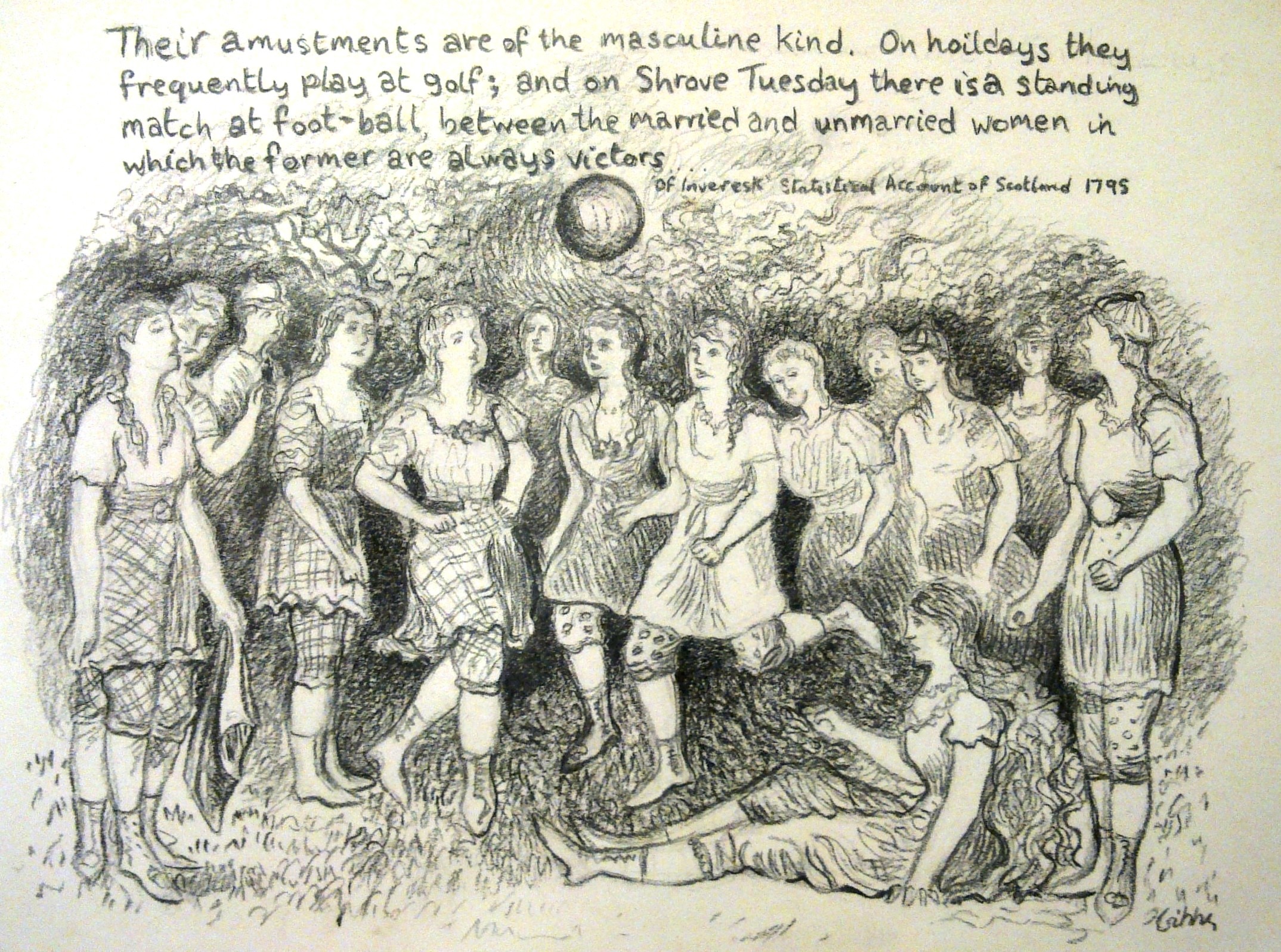
As they do the work of men, their manners are masculine, and their strength and activity is equal to their work. Their amusements are of the masculine kind. On holidays they frequently play at golf, and on Shrove Tuesday there is a standing match at foot-ball, between the married and unmarried women, in which the former are always victors.”
This observation was made by Dr Alexander Carlyle, Minister of Inveresk Parish, and relates to the Fishwives of Fisherrow in East Lothian. The account provides an early example of a women only football game in Scotland.
Although football games were commonly played at Fastern’s E’en (Shrove Tuesday) with the players being split into “married” and “unmarried” teams, the vast majority of these contests were men-only affairs. The minister suggests that the hard working life of the fishwives resulted in them enjoying recreational activities which were normally associated with men. It also points to the collective strength and degree of empowerment that the women enjoyed within their local community.
Another example of a women only football match can be found at Lennel, near Coldstream in the Scottish Borders in 1786. That match took place on Ash Wednesday and ended in a draw as we are told that “darkness prevented victory being declared on either side”.
We are grateful to artist and historian Stuart Gibbs for granting us permission to use the sketch.
1815
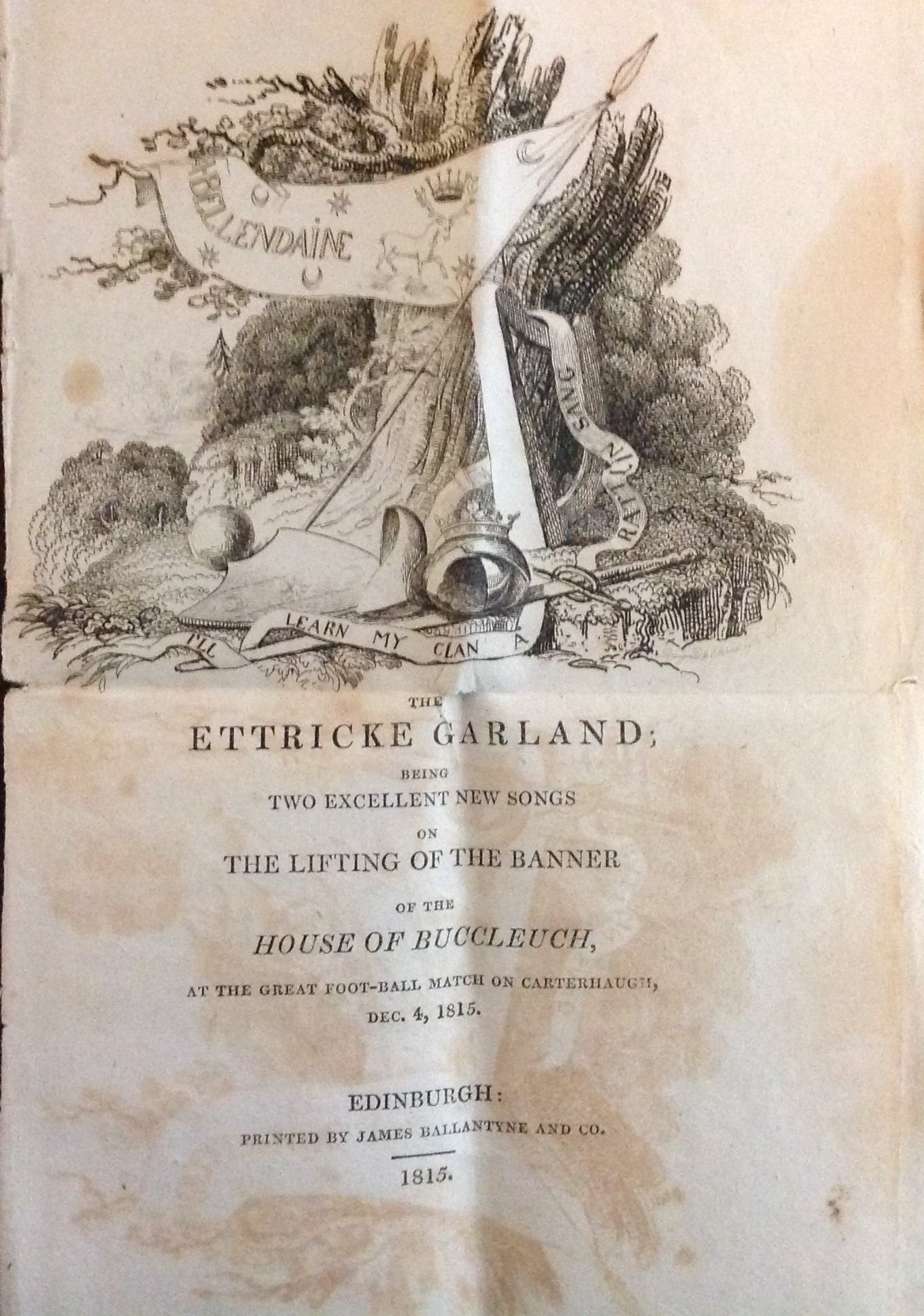
THE ETTERICKE GARLAND
Commemorating the story of the
Carterhaugh Ba’ Game.
Learn More
In 1815 Sir Walter Scott composed a song entitled “On the lifting of the Banner of the House of Buccleuch at a great foot-ball match at Carterhaugh”.
In 1815 Sir Walter Scott and the Duke of Buccleuch organised a football match at Carterhaugh near Selkirk in the Scottish Borders. Teams representing Yarrow and Selkirk took part in the contest; the Selkirk party were identified by slips of fir with the Yarrow men wearing sprigs of heath.
The ancient banner of the Buccleuch family was carried onto the field ahead of the game amongst a fanfare of pageantry. The Duke himself threw up the ball to start the game. The first game was won by the men of Selkirk after an hour and a half’s play. The second game was won by Yarrow after a gruelling contest which lasted more than three hours. A conclusive game could not be organised and the day ended in a draw.
To commemorate the occasion, two songs were published under the title of Ettricke Garland. Perhaps the most famous lines penned by Scott which relate to the Carterhaugh Ba’ game are the following…
Then strip, lads, and to it, though sharp be the weather,
And if, by mischance, you should happen to fall,
There are worse things in life than a tumble on heather,
And life is itself but a game at football.
1818
VILLAGE BA’ GAME, OIL ON CANVAS
Alexander Carse paints The Village Ba’
Game.
Learn More
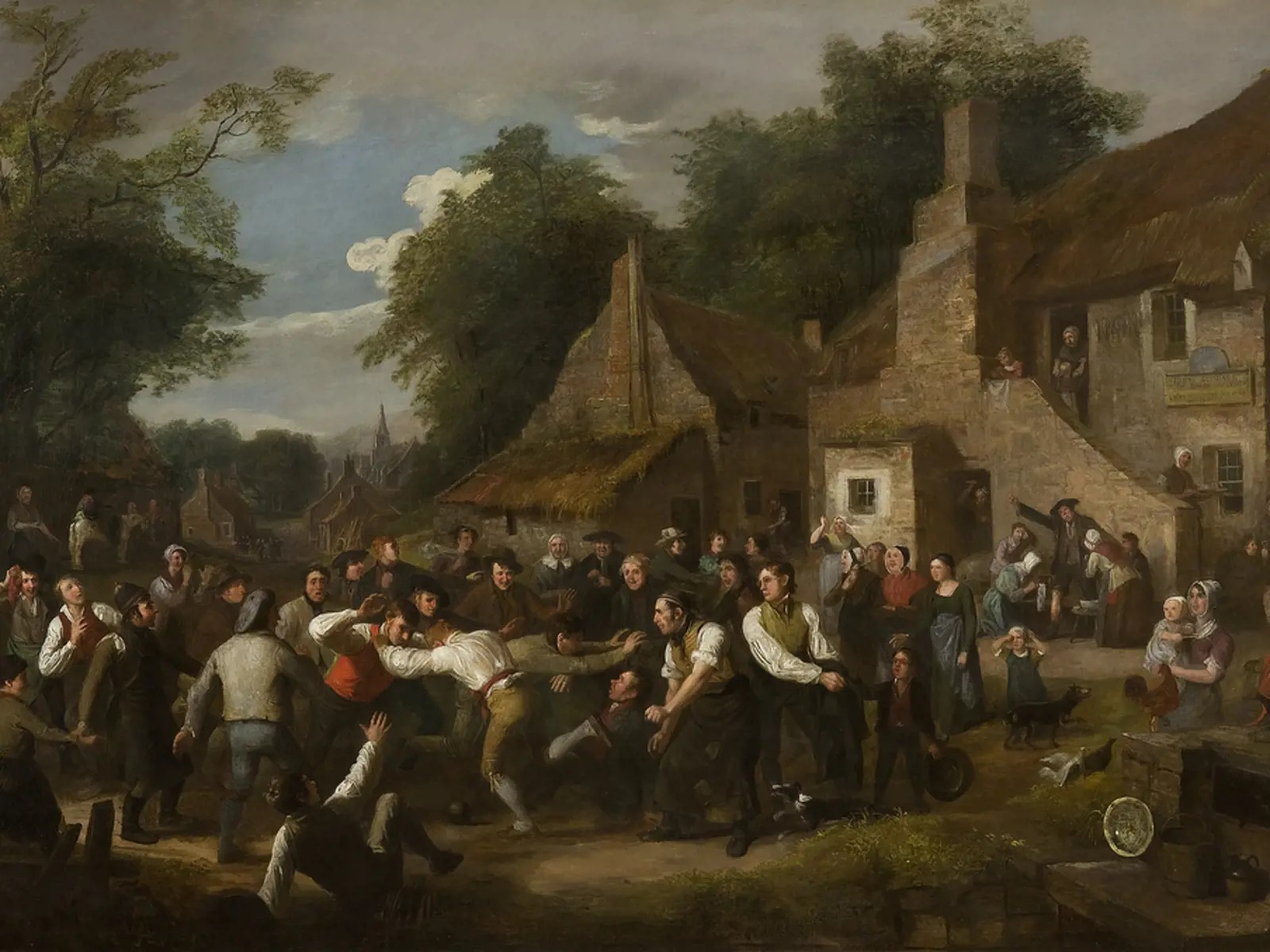
Carse’s detailed study presents the viewer with a fascinating insight into football as an ancient folk tradition.
Scottish artist Alexander Carse painted this scene of a rustic football game in 1818. Although the exact location is not known, it is thought to be from the Scottish Borders area. Carse was particularly noted for capturing scenes of everyday Scottish life and there are three known paintings of football games attributed to him.
This painting depicts the rough and ready nature of a typical rural football game at a time of great change. Between 1750 and 1850 Scotland was gradually being transformed from a country that was overwhelmingly rural and agricultural into one which was becoming increasingly urban and industrial for a majority of the inhabitants.
The scene painted by Carse was once a common sight in many of Scotland’s villages and small towns. Today these annual folk customs can only be seen in the form of Hand Ba’ in the Scottish Borders and at Kirkwall in the Orkney Isles.
1824
EXPENSES OF THE FOOT-BALL
CLUB
The World’s First Football Club.
Learn More
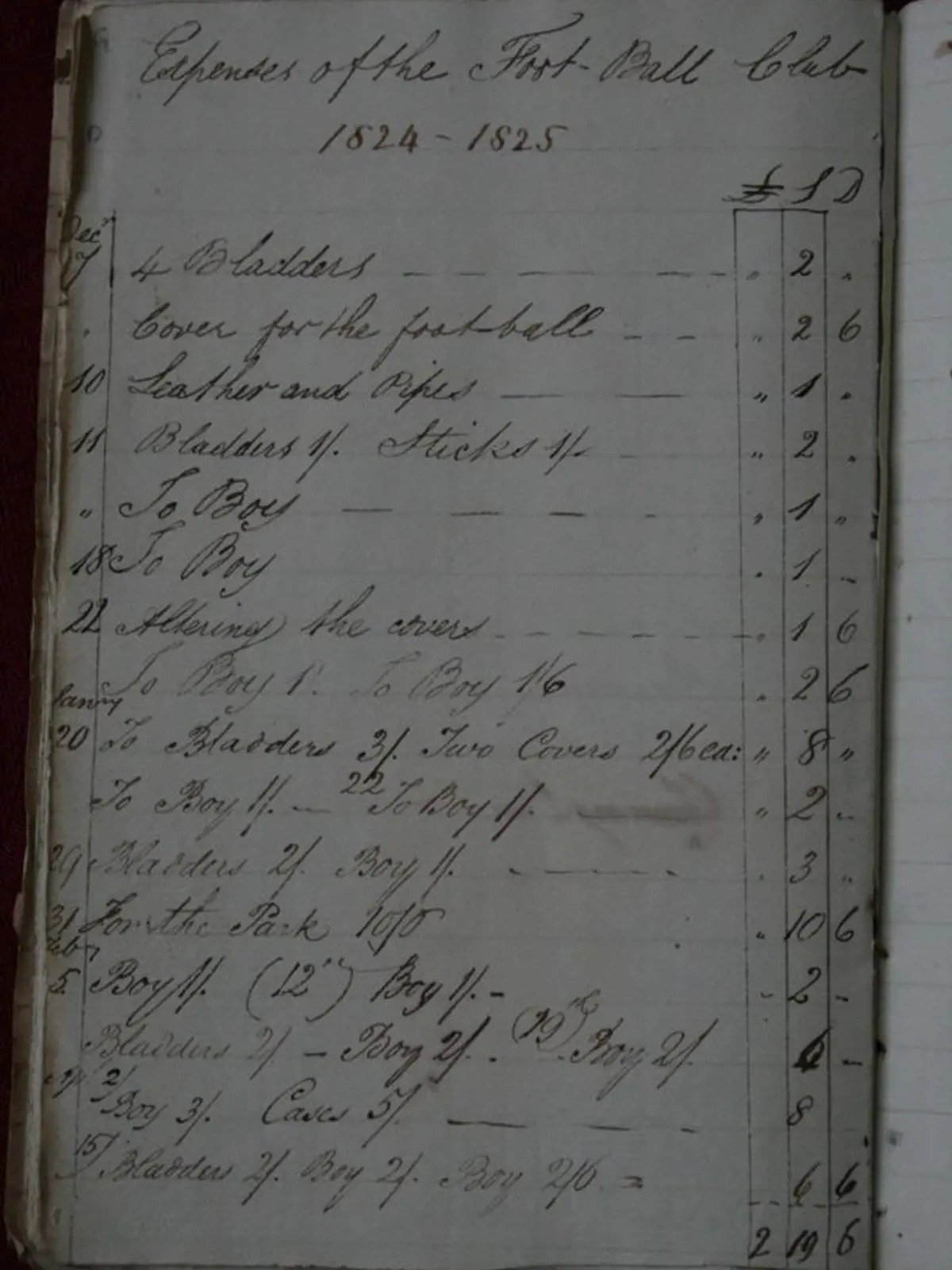
This book details the expenses accrued by the first known football club in the world. The club was formally established in Edinburgh by John Hope towards the end of 1824. Hope was a student at Edinburgh University at the time. Surviving documentation relating to the club tells us that it continued up until 1841. As well as an expenses book, the earliest documents relating to the club include a list of members with a note of their membership fees.
Like Hope, many of the other members appear to be young men from affluent families, mainly from the New Town of Edinburgh. The club archive provides a fascinating insight into the level of organisation that was required to organise games. Bladders and leather casings had to be ordered for making up the footballs, fees were paid out for leasing parks to stage the matches, a “boy” was required to assist with getting the equipment and the park set up for the games.
Additional entries in the records refer to “hail sticks” (goal posts) and in a record from 1833, there is a handwritten note outlining playing rules. Hope organised the members into categories, depending on the days in which they were available to participate in the games. This ensured that the number of players could be regulated ahead of each of the games.
1851
football medallion
The oldest football Trophy
Learn More
The match, which was the best of five games [goals], was played in presence of a vast multitude who assembled to witness the trial and agility, for a handsome… medal, a prize which will be presented by the losing party to the successful competitors (Bell’s Life in London and Sporting Chronicle, 02/02/1851, P6).”
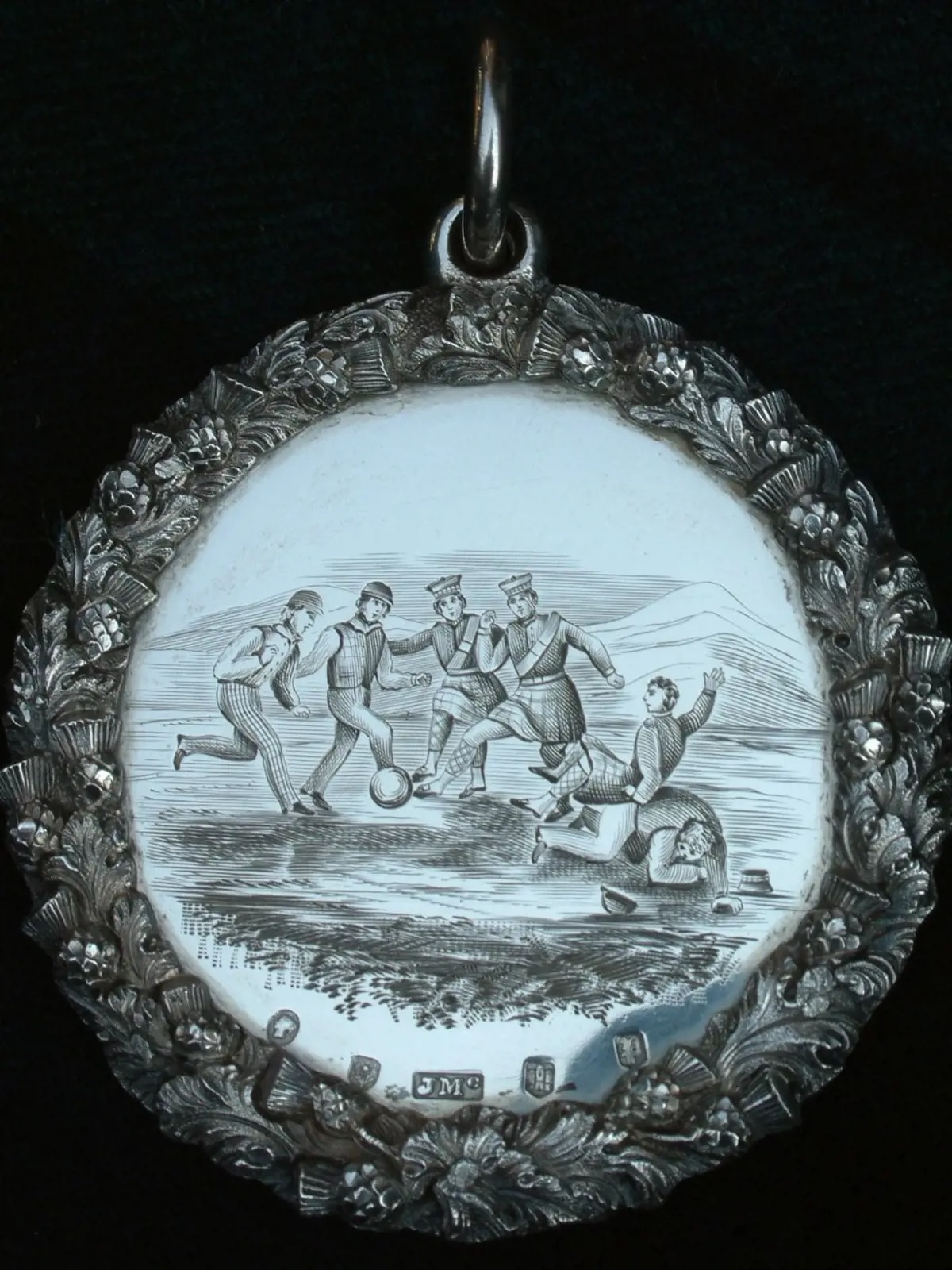
This magnificent silver medallion was the “prize” awarded to the football team of the 93rd (Sutherland) Highlanders when they defeated the Edinburgh University Football Club on 25th January 1851. As the medallion was presented to the full team rather than being awarded to one of the players it can be considered to be a sporting trophy and as such is the earliest surviving example of a football trophy.
The 93rd Highlanders won the match by 3 games [goals] to nothing and true to their word, the Edinburgh University Football Club presented this medallion to the regiment afterwards. A scene from the game, which took place at Holyrood Park in Edinburgh, is engraved onto the medallion which is in the collection of the Argyll and Sutherland Highlanders Museum at Stirling Castle.
1854
RULES OF THE STOCKBRIDGE PLAYGROUND
The Stockbridge Rules.
Learn More
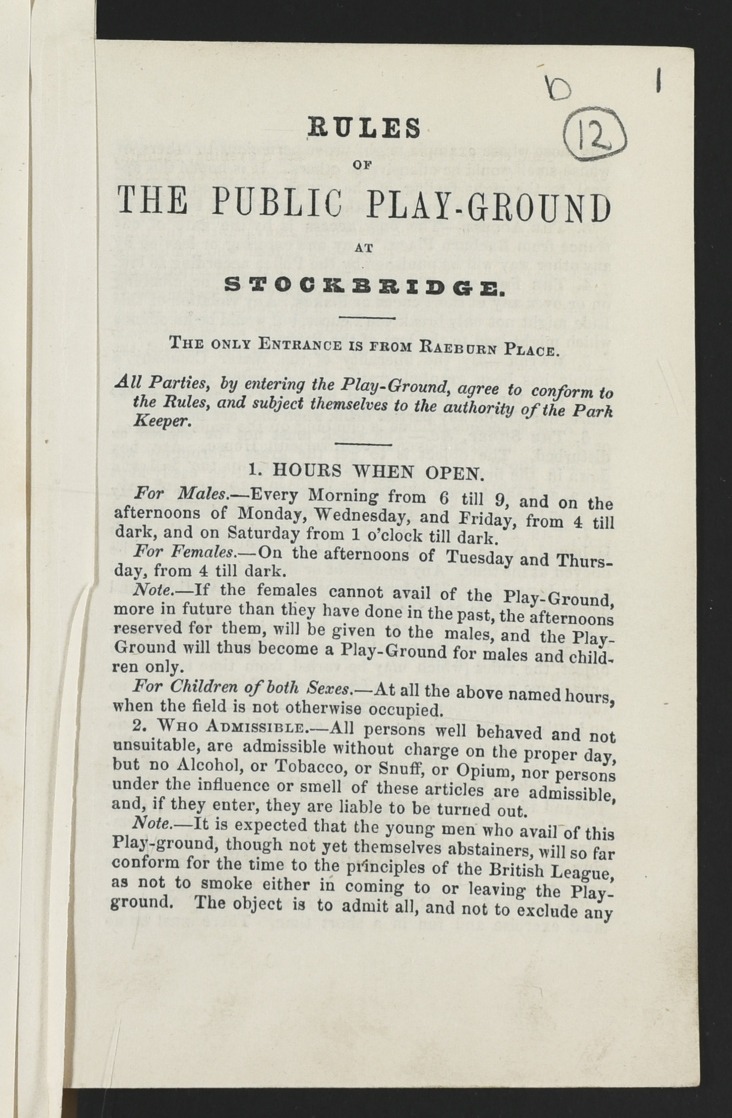
In 1854, John Hope, the founder of the world’s first football club, opened a public playground at Stockbridge in Edinburgh and published a set of rules for football.
By the 1850s Hope was significantly involved in the temperance movement and could see the value of healthy outdoor recreation as an alternative to the vice of alcohol. What makes his set of football rules standout for the period is the fact that they were aimed primarily at a section of Edinburgh’s working class population.
Two points within the overall rules for the Stockbridge playground are of particular interest. Point 11 states that “those in the same shop or establishment, or… in the same occupation… should form themselves into Clubs for Games.” Point 9 addresses the types of games to be played by the clubs at the park and football is singled out with a set of playing rules included.
The passage referring to the rules reads as follows:
- The Game of Foot-Ball is strongly recommended, as giving most exercise and fun in a short time.
- There must be no kicking of shins, nor tripping – for these are apt to produce quarrels and hurts, and do not form part of the game.
- The ball is not “hailed,” [scored] unless it is sent between the posts, by one of the side whose duty it is to send it through, and unless it touch the ground.
- If the ball is sent through by one of the other side, it is not “hailed.”
- The Ball should not be kicked out of bounds.
- When this occurs, it should be lifted up by the hand, and brought within bounds. The party thus lifting it, is entitled to a “free kick,” but the ball must not be lifted by the hand from the ground at any other time.
- The British League Cap, to distinguish sides, cost 2d, is recommended.
1857
MINUTE BOOK OF THE EDINBURGH ACADEMICAL FOOTBALL CLUB
Edinburgh Accies; Scotland’s Oldest
Football Club.
Learn More
The Edinburgh Academical Football Club is Scotland’s oldest existing football club as well as the first club in Scotland to play to the rugby football code.
Formed in 1857 as a former pupils team linked to the Edinburgh Academy, the earliest records relating to the Edinburgh Academical club refer to the receipt of payments, including subscription fees, made in December 1857. David R. Lyall and Alexander Crombie are amongst the first of the committee members to be referenced in the club records.
The Academical Club was a powerhouse of rugby football in Scotland, providing leadership as the game expanded during the 1860s and supplying players for the Edinburgh select team and Scotland national rugby team from the 1870s onwards. The “Accies” in tandem with a number of the other leading rugby clubs was instrumental in creating uniform playing rules for the rugby game in Scotland in 1868 (informally referred to as the Green Book).
Accies played a significant role in organising the first international match of 1871 (played at Raeburn Place, their home ground) and in the formation of the Scottish Football Union (Scottish Rugby) in 1873.
1867
FIRST MINUTES OF THE QUEEN’S PARK FOOTBALL CLUB
Queen’s Park FC; pioneers of Association
football.
Learn More
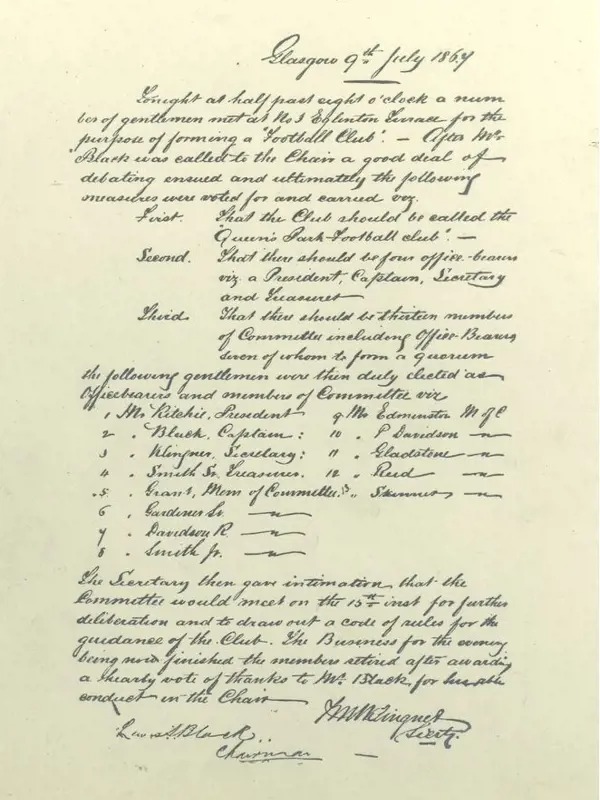
Tonight, at half-past eight o’clock, a number of gentlemen met at No. 3 Eglinton Terrace for the purpose of forming a “football club”
Glasgow’s oldest Association club was officially constituted on 9th July 1867. A passionate debate over the name of the club included titles such as “Northern”, “Morayshire” and “The Celts”, reflecting the northern roots of many of its original members. Eventually “Queen’s Park Football Club” was agreed to, in recognition of the local park in Glasgow’s south side which hosted early games.
Similar to the Foot-Ball Club of 1824, Queen’s Park’s original ethos was that “its object shall be the recreation and amusement of its members”. Games were organised three times a week and the club members were divided up into teams. It would be August 1868 before Queen’s Park would find another opponent to play against. Matches against other clubs followed.
s well as organising the world’s first official international football match under Association rules, Queen’s Park took an active interest in the playing rules and set out to grow the game by organising exhibition games in other parts of Scotland. By doing so, the club quickly turned their short passing game into a Scottish style. In March 1873 Queen’s Park organised the meeting which led to the creation of the Scottish Football Association and Scottish Cup competition.
1871
PHOTOGRAPH OF THE SCOTLAND MEN’S RUGBY FOOTBALL TEAM
Raeburn Place; official birthplace of international football (Rugby Rules).
Learn More
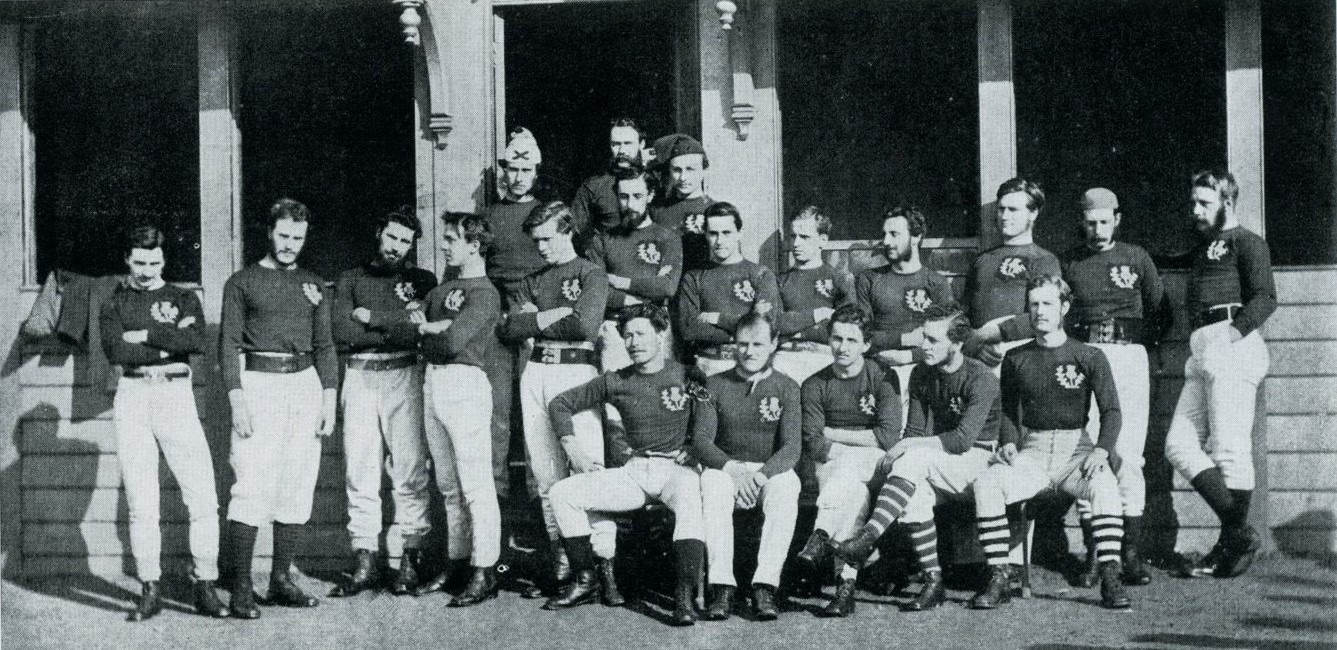
On 27 March 1871 Scotland met England at Raeburn Place in Edinburgh to contest the world’s first official men’s international football match. The game was played under rugby football rules.
The first rugby international took place as a result of an unofficial match which had been organised by the Football Association in London in 1870 between players representing Scotland and England under the Association code.
A letter was subsequently printed in the Scotsman newspaper, issued by representatives of four of Scotland’s leading clubs, which set out a challenge for an international match to be played under rugby rules.
The historic game at Raeburn Place was played at 20 a-side and ended in a victory for Scotland by a goal and two tries to one try. Since 1879 the fixture has been commemorated with the winning team receiving the historic Calcutta Cup.
1872
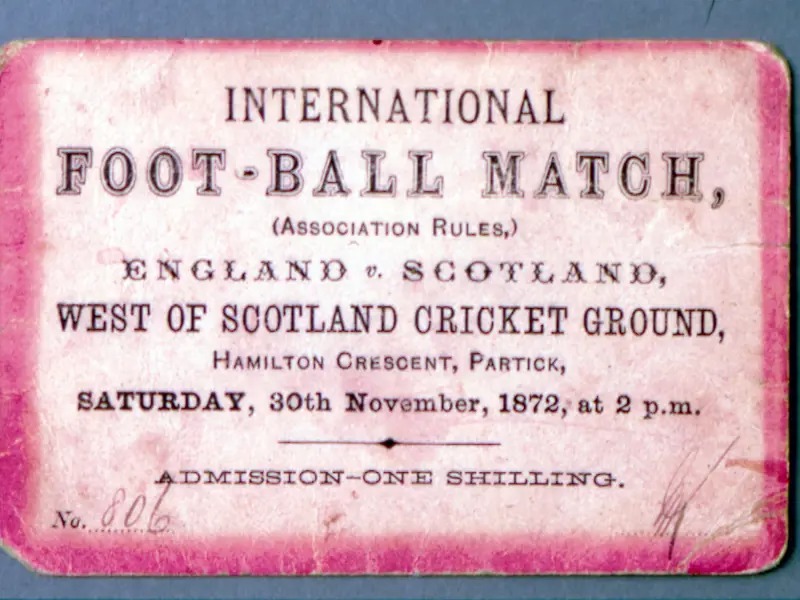
MATCH TICKET FROM FIRST OFFICIAL INTERNATIONAL FOOTBALL MATCH
West of Scotland Cricket Ground; official
birthplace of international football (Association Rules).
Learn More
On St Andrews Day 1872, the first official men’s international football match under the Association code took place at the West of Scotland Cricket Ground at Hamilton Crescent in Partick. In 1872, Partick was an independent burgh but now forms part of the west end of Glasgow.
In this match, a Scotland team, made up entirely of members of the Queen’s Park Football Club, lined up against a formidable England team. Approximately 2,500 spectators paid a shilling to watch the game. Contemporary match reports describe the difference in playing styles between the two teams. Individual play was the predominant style of the England team who used skill, pace and brawn to pilot the ball forward.
The Scots, setting up in pairs, dribbled the ball but they also played short passes to play their way around their opponents. The game ended in a draw but the systematic blend of dribbling and short passing adopted by the Scots would go on to transform the association game. The match was considered a success and led to an “explosion” of football across Glasgow and the west of Scotland with dozens of clubs springing up almost overnight.
1873
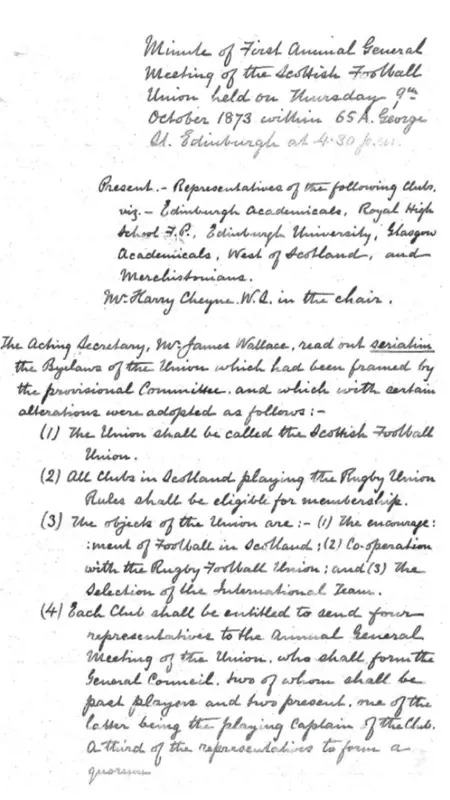
MINUTE OF THE FIRST AGM OF THE SCOTTISH FOOTBALL
UNION
Birth of The Scottish Football Union.
Learn More
By 1873 Rugby football was booming across Scotland; clubs could be found playing to the rugby code from the Scottish Borders (Langholm FC) up to Ross & Cromarty (Black Isle Wasps FC). The creation of a national governing body was needed by 1873 to support the administration of the game in general and take formal control of the national team.
The Scottish Football Union (SFU) was founded in Glasgow on 3rd March 1873, immediately after the third rugby international match between Scotland and England. The following eight clubs met at Glasgow Academy to establish the SFU; Glasgow Academicals, Edinburgh Academicals, West of Scotland, St Andrews University, Royal High School F.P. ‘s, Merchistonians, Edinburgh University and Glasgow University. The club representatives elected a committee with John Chiene of the Edinburgh Academical Club becoming the first president of the Scottish Football Union.
The Scottish Football Union kept its title up to 1924 when it changed to the Scottish Rugby Union. The following year Murrayfield opened as the national stadium for Scottish Rugby. Murrayfield remains the administrative headquarters for Scottish rugby as well as being home to the Scotland national team.
1873
sCOTTISH FOOTBALL ASSOCIATION CASH BOOK
Birth of the Scottish Football Association
Learn More
Following on from the success of the first official international football match under Association rules, it became evident to Queen’s Park FC and the other early teams that a governing body be established.
The meeting to institute the Scottish Football Association took place at Dewar’s Hotel in Glasgow on 13 March 1873. Joining Queen’s Park at the historic first meeting were the Clydesdale, Vale of Leven, Dumbreck, Third Lanark, Eastern and Granville clubs. An eighth club, Kilmarnock FC, submitted a letter of support.
An important decision within the inaugural meeting was that the clubs in membership subscribe towards the purchase of “a Challenge Cup to be played for annually.” The Scottish Cup competition was thus born.
The first committee and office bearers were voted in and the Constitution and Rules of the Association were agreed to and framed. The earliest pages of the Scottish FA cash book primarily cover membership subscriptions, the purchase of the cup and “11 silver gilt badges” and the hosting of the international match against England in 1874.


Football For All
Local Heritage Grants
The Local Heritage Grants have been made possible with the support of the players of The National Lottery and The Heritage Fund.
The Football For All project will culminate with a series of local projects across Scotland to mark the 200th anniversary of the oldest documented football club in the world – The Foot-Ball Club, Edinburgh.
Local Heritage Grants of up to £1,500 were made available to help communities in Scotland celebrate their local football heritage, engaging new and different audiences with football history.